Stablecoin payments guide for businesses: USDT, USDC, and beyond
From accepting USDT payments to managing stablecoin B2B settlements, this guide explains how businesses use USDC, digital dollars, and stablecoin payment gateways.

TL;DR
Stablecoins, primarily USDT and USDC, are dollar-pegged digital currencies that settle payments in seconds.
Total stablecoin on-chain transfer volume hit $33 trillion in 2025, a 72% year-over-year jump.
The stablecoin market cap crossed $300 billion in early 2026, with USDT and USDC accounting for over 95% of total supply.
USDT leads in global liquidity and emerging-market reach. USDC leads on regulatory compliance, aligned with the US GENIUS Act and EU MiCA.
The GENIUS Act was signed into US law on July 18, 2025, giving businesses the first clear federal framework.
Stablecoin cross-border payments cost 0.1-0.5% of transaction value vs. 6% for traditional international remittance (Moody’s Ratings).
77% of corporate stablecoin users cite supplier payments as their primary use case.
Businesses accepting stablecoins are not stablecoin issuers and are not subject to PPSI licensing; the main obligations are KYC/AML at the gateway level.
Speed accepts both USDT and USDC across 100+ countries, settles in under 3 seconds, and carries SOC2 Type 2, PCI-DSS, and ISO 27001 certifications with built in KYC/AML.
The shift in how global business payments move
International wire transfers take 1-5 business days. Credit card fees consume 2.5-3.5% of every transaction before currency conversion is factored in. Chargebacks arrive weeks or months after the original transaction and carry dispute costs that cut further into margin.
These are not exceptional cases; they represent the standard operating model for cross-border business payments.
Stablecoins change the underlying rails. Because they run on public blockchain networks, they confirm in seconds, at any hour, from anywhere in the world.
Because they maintain a stable dollar peg, they remove the volatility that made earlier cryptocurrency payments impractical for accounts payable, payroll, or merchant checkout.
The scale of adoption makes this a business infrastructure story rather than a crypto market story. USDT and USDC together moved $31.6 trillion in on-chain volume in 2025.
More than 232 million blockchain addresses hold stablecoins globally. The stablecoin market cap crossed $300 billion in early 2026.
Behind those numbers are businesses, manufacturers paying suppliers, platforms settling with contractors, and merchants accepting payments from international buyers. All are choosing stablecoin rails over the traditional correspondent banking system.
This guide covers everything a business needs to understand about stablecoin payments. How USDT and USDC differ, where they genuinely outperform traditional payment methods, and what the current regulatory environment requires, what to look for in a payment gateway, and how to set up a compliant stablecoin payment flow through Speed.
What is a stablecoin?
A stablecoin is a cryptocurrency designed to hold a stable value, almost always pegged 1:1 to the US dollar. One USDT and one USDC are each designed to equal one US dollar, maintained through reserves of cash, government bonds, and other liquid assets.
This stability is precisely what traditional cryptocurrencies like Bitcoin and Ethereum have historically lacked for payment purposes.
A company invoicing a client in USDC can receive $50,000 and know the value will still be $50,000 the next morning. A supplier paid in USDT holds a dollar-denominated asset rather than a position in a volatile commodity.
Why are businesses paying attention?
Four structural properties make stablecoins operationally relevant for business:
Settlement speed
Transactions are confirmed in seconds on networks like Tron, Solana, and Lightning Network, and within minutes on Ethereum. There are no banking hours, clearing windows, or public holiday delays. A payment initiated at 11 pm on a Sunday settles before midnight.
Transaction cost
On Tron or Solana, a USDT or USDC transfer costs a fraction of a cent. On Ethereum, fees vary by network congestion, but rarely exceed a few dollars.
This compares to wire transfer fees of $20-$50 per transaction plus corresponding bank charges, and card interchange rates of 2-3% on the transaction amount.
Irreversibility
Once confirmed on the blockchain, a stablecoin payment cannot be reversed. This means no chargebacks, no friendly fraud, and no dispute resolution overhead.
Programmability
Stablecoin transactions can be embedded with logic, payment conditions, scheduling, and batch routing without additional middleware. This is the foundation for programmable payroll, automated supplier payments, and subscription billing on blockchain rails.
Stablecoins offer core technical advantages in their near-instant 24/7 settlement and the ability to support programmable payments.
— Moody's Ratings, May 2026
How stablecoins address what traditional payments can't
Stablecoins work best as a supplementary or alternative payment rail where traditional options are slow, expensive, or geographically unavailable.
They do not replace all payment methods, as card acceptance remains necessary for most consumer-facing businesses, but they provide a genuinely better option in specific contexts.
The cost comparison on cross-border payments is the most concrete evidence. Stablecoins settle for 01% to 0.5% of transaction value, compared to the 6% + average for international remittance.
A McKinsey and Artemis Analytics study found that stablecoin payment activity, like covering vendor payments, remittances, payroll, and B2B settlement that doubled in 2025 to approximately $390 billion.
EY-Parthenon’s post-GENIUS Act survey found that 41% of corporate stablecoin users reported cost savings of at least 10%, primarily on cross-border supplier payments, and that 77% of corporate users cited supplier payments as their primary use case.
Industry adoption will rely heavily on a combination of greater regulatory clarity and partnerships that can help alleviate the complexity of launching, using, and managing stablecoins.
— S&P Global Market Intelligence, May 2026
Speed matters differently by industry. An eCommerce merchant receiving payment from a buyer in another country gets funds in seconds rather than waiting for a T+2 card settlement cycle.
A payroll team paying contractors across five countries processes all of them simultaneously in a single batch, without pre-funding local accounts in each jurisdiction.
The elimination of chargebacks is a structural benefit for any business that has experienced friendly fraud. Because stablecoin payments are irreversible on confirmation, the primary mechanism for post-delivery disputes, the chargeback, does not exist. For merchants in categories with high dispute rates, this changes the risk profile of each transaction.

Understanding USDT, USDC, and the digital dollar landscape
The stablecoin market has two dominant assets: USDT (issued by Tether) and USDC (issued by Circle). Together, they account for over 95% of the outstanding stablecoin supply globally.
For any business building stablecoin payments into its operations, understanding the distinction between them is a practical necessity, not a technical detail.
USDT (Tether): The liquidity leader
Tether launched USDT in 2014, making it the oldest and largest stablecoin by market cap, exceeding $187 billion as of early 2026. USDT is available on more blockchains than any other stablecoin, including Ethereum, Tron, Solana, BNB Chain, Avalanche, Lightning, and others.
This multi-chain availability and deep exchange liquidity make it the most accessible dollar-denominated digital asset in markets where crypto infrastructure exists, but traditional banking is limited.
USDT holds particularly strong adoption across Southeast Asia, Eastern Europe, Turkey, and Latin America, where it serves as a practical dollar alternative for both value storage and payment.
Businesses paying suppliers or contractors in these regions often find that USDT is the stablecoin their counterparties can actually receive and access.
Tether has faced historical scrutiny over the composition and transparency of its reserves. The company publishes quarterly attestations, and the reserve picture has become significantly cleaner since 2021.
USDT reserves are predominantly US Treasury bills, cash equivalents, and secured loans. However, these attestations are not monthly and are not full audits in the GAAP sense.
The EU’s MiCA regulation has resulted in USDT being restricted or delisted on several regulated European exchanges, as Tether does not yet meet all requirements for electronic money token issuers under that framework.
USDC (USD Coin): The compliance-first stablecoin
Circle launched USDC in 2018 as a fully transparent, regulated stablecoin. Its reserves consist entirely of cash and short-term US Treasury securities, with monthly third-party attestations published publicly.
This reserve transparency is what distinguishes USDC’s compliance posture from Tether’s and why institutional, regulated platforms, and US -based businesses have increasingly adopted it.
USDC is fully compliant with the GENIUS Act and MiCA, positioning it as the default choice for businesses operating in or targeting regulated financial ecosystems in the US and EU.
Mastercard and Visa have both launched stablecoin spending products built on USDC. In March 2026, Circle processed $68 million across eight entities in under 30 minutes, demonstrating enterprise-grade settlement capability at scale.
Between 2024 and the first half of 2025, USDC merchant payment volume grew 337%-a rate driven by institutional credibility, regulatory compatibility, and the expanding number of regulated payment rails that integrate USDC directly.
US-based merchants in particular are gravitating toward USDC because of its cleaner regulatory position under the GENIUS Act and the infrastructure being built around it by Visa, Mastercard, and major banks.
USDT vs. USDC: What does the difference mean for your business?
Feature | USDT (Tether) | USDC (Circle) |
|---|---|---|
Issuer | Tether Holdings | Circle Internet Group |
Supply (early 2026) | ~$187B | Fast growing |
Reserve composition | T-bills, cash, secured loans | Cash + US Treasuries only |
Reserve attestation | Quarterly | Monthly third-party |
GENIUS Act compliance | Partial | Full |
MiCA compliance | Restricted in the EU | Fully compliant |
Blockchain support | Ethereum, Tron, Solana, BNB, + more | Ethereum, Solana, Base, Polygon, + more |
Institutional adoption | Broad globally | Strong in US/EU regulated channels |
Best for | Global liquidity, emerging markets | Regulated markets, US/EU, institutions |
Merchant volume growth (2024–H1 2025) | Dominant by total volume | +337% year-over-year growth rate |
For businesses that need maximum global reach and operate in markets where USDT has established infrastructure, it remains the practical choice. For businesses integrating with regulated financial infrastructure, US-based merchants, or those operating in the EU, USDC’s regulatory standing makes it the safer long-term primary stablecoin.
Speed accepts both, with settlement options across multiple chains.

Other stablecoins worth knowing
Beyond USDT and USDC, several other stablecoins occupy specific niches. PayPal's PYUSD has grown within PayPal's own network and is being used for Xoom's cross-border remittance flows, with PayPal marketing it as a way to escape "traditional banking hours." Ripple's RLUSD has entered the enterprise payments space.
MakerDAO's DAI is a decentralized stablecoin backed by crypto collateral, used primarily within DeFi protocols.
For the practical business payment use cases covered in this guide — supplier payments, payroll, eCommerce, B2B settlement, USDT and USDC cover the overwhelming majority of what is needed.
The regulatory environment shaping stablecoin payments
Regulatory uncertainty has historically been the largest obstacle to wider business adoption of stablecoin payments. Two major frameworks have significantly reduced that uncertainty since mid-2025.
The GENIUS Act: The United States’ first federal stablecoin law
The Guiding and Establishing National Innovation for U.S. Stablecoins Act was signed into US law on July 18, 2025, by President Trump.
It establishes the first comprehensive federal regulatory framework for payment stablecoins in the United States.
President Trump is strengthening American leadership in digital financial technology. This proposal will protect the U.S. financial system from national security threats without hindering American companies' ability to forge ahead in the payment stablecoin ecosystem."
— Scott Bessent, U.S. Secretary of the Treasury, April 2026
The GENIUS Act creates a licensing framework for “permitted payment stablecoin issuers” (PPSIs), establishes AML and sanctions compliance requirements through FinCEN and OFAC, and sets capital and reserve standards for issuers.
Full implementing regulations from the FDIC, OCC, and Federal Reserve are expected throughout 2026 and 2027. Issuers with outstanding supply above $10 billion must transition to the federal regime or cease issuance.
The FDIC issued a proposed rulemaking on April 7, 2026, to implement GENIUS Act requirements for FDIC-supervised permitted payment stablecoin issuers.
The OCC issued proposed regulations in March 2026 covering the application requirements, reserve standards, and custody rules for OCC-licensed stablecoin issuers.
Treasury’s FinCEN and OFAC jointly issued proposed rules for AML and sanctions compliance programs for PPSIs in April 2026.
For businesses accepting stablecoins as payment rather than issuing them, the GENIUS Act's primary practical effect is creating a more stable, trusted, and well-regulated stablecoin ecosystem.
Businesses receiving USDC or USDT from customers are not subject to PPSI licensing requirements. Their obligations lie in standard AML/KYC compliance at the payment gateway level.
MiCA: The European Union's framework
The EU’s Markets in Crypto-Assets (MiCA) regulation came into effect in 2024 and has had immediate practical consequences for the European stablecoin market. USDT was delisted or restricted on several regulated European exchanges because Tether does not fully meet MiCA’s requirements for electronic money token issuers.
USDC, issued by Circle, is MiCA-compliant and has become the default institutional stablecoin for European payments and treasury operations.
For any business operating in the EU or accepting payments from European customers, USDC is the compliant choice under the current regulatory framework.
What does compliance mean for businesses accepting stablecoins?
Businesses that accept stablecoins as a payment method, as distinct from issuing stablecoins, have a different and lighter compliance burden than PPSI issuers. The primary requirements include:
KYC/AML obligations that apply at the customer verification level, handled by the payment gateway. Sanctions screening to ensure payments are not received from or sent to sanctioned entities.
Accurate record-keeping for tax purposes, as stablecoin payments are treated as property transactions in the US, each receipt may constitute a taxable event if the stablecoin was acquired below or above its cost basis.
Businesses that immediately convert received stablecoins to fiat are generally treated similarly to those handling foreign currency conversions.
Choosing a payment gateway that handles KYC/AML, sanctions screening, and transaction monitoring at the infrastructure level significantly reduces the compliance overhead on the business itself.
Speed's compliance infrastructure covers SOC2 Type 2, PCI-DSS, ISO 27001, and a full KYC/AML framework. Businesses using Speed operate within a compliance layer that is already built to the GENIUS Act and MiCA requirements.
Build on compliant stablecoin infrastructure
Speed is SOC2 Type 2, PCI-DSS, and ISO 27001 certified — with KYC/AML built in so your business doesn't have to build it separately.
Stablecoin payments across industries: Real use cases
eCommerce and online marketplaces
Online merchants face three specific problems with stablecoin payments that can be addressed directly:
Card processing fees that average 2.5-3.5%, chargeback exposure that extends 120 days after the transaction, and cross-border settlement delays that hold liquidity in transit for 2-5 days.
An eCommerce merchant accepting USDC from a buyer in Germany receives funds that settle in seconds at approximately 0.5-1% processing cost, with no chargeback mechanism.
For marketplaces with sellers distributed across multiple countries, stablecoin payouts replace slow bank transfers.
A platform paying 500 sellers across 40 countries processes all payouts simultaneously in a single settlement cycle rather than managing local banking relationships and currency conversion in each market.
The practical outcome is improved cash flow, reduced fraud-driven losses, and payment access in markets where card penetration is lower. For businesses in crypto-adjacent product categories like gaming merchandise, digital assets, and online media.
A meaningful portion of buyers already hold and prefer to spend in USDT or USDC.
Speed’s eCommerce and Marketplace payment infrastructure supports USDT and USDC checkout via payment links, API integration, and WordPress/WooCommerce plugins with same-day settlement.

B2B and supplier payments
B2B payments are the largest and fastest-growing category of real-economy stablecoin use. McKinsey estimates annualized B2B stablecoin flows at $226 billion, representing approximately 60% of identifiable real-economy stablecoin activity.
EY-Parthenon’s corporate survey found that 77% of stablecoin-using businesses cite supplier payments as their primary use case.
The mechanics are straightforward. A US manufacturer purchasing components from a supplier in Vietnam sends USDT via Tron in seconds rather than initiating an international wire that takes 3-5 business days and arrives with correspondent bank fees deducted.
The supplier receives the full agreed amount. The manufacturer avoids the wire fee, the conversion spread, and the uncertainty of what the supplier will actually receive.
For businesses that make recurring supplier payments, weekly, bi-weekly, or monthly, the operational savings compound. A company running 50 international supplier payments per month at $40 average wire cost saves $24,000 annually in wire fees alone, before factoring in the value of funds that arrive days faster.
Even in cross-border remittance, which is one of the best use cases of stablecoin today, it's really corridor-dependent where it actually makes sense and is better, faster, cheaper.
— Kevin Lehtiniitty, CEO, Borderless Innovation Labs, Stable SF 2025

Cross-border payroll and contractor payments
International payroll carries some of the highest fees in the business payment stack. Wire transfers to contractors in emerging markets carry fees of 3-8% when all conversion and correspondent banking costs are included.
Services like Western Union or PayPal carry similar or higher costs in specific corridors.
Stablecoin payroll changes the equation. A company based in the US pays a contractor in the Philippines, Turkey, or Argentina in USDC. The contractor receives the full amount in a dollar-denominated asset that protects them from local currency depreciation, a material benefit in countries with volatile fiat currencies.
The company processes the payment at under 1% cost, settles it in seconds, and has a complete on-chain record for accounting purposes.
The BIS estimates cross-border flows between USDT and USDC at approximately $400 billion per year. A significant portion of this represents payroll and contractor payment flows, particularly in corridors between the US and Southeast Asia, Latin America, and Eastern Europe.
For remote-first companies managing teams across multiple countries, stablecoin payroll is increasingly the most cost-efficient and operationally straightforward payment method available.
Gaming and digital entertainment
Online gaming and entertainment platforms have payment needs that stablecoins address particularly well, such as instant payouts to players and streamers, cross-border prize distributions, in-game economics denominated in stable currency, and a user base that already holds and uses crypto assets.
Player payout delays are a significant source of friction on gaming platforms. A player who wins a tournament and must wait 5-7 business days for bank transfer settlement has a materially different experience than one who receives USDT within seconds.
For platforms with high payout volume, live streaming platforms pay out tips, gaming platforms settle winnings, and skill games distribute prizes. The difference in payout speed affects retention and player satisfaction directly.
Desiree Dickerson, CEO of Thndr Games — a Speed customer — noted: "From deposit withdrawal, our players are getting lightning-fast payouts.
Speed’s gaming and entertainment infrastructure supports instant Bitcoin and stablecoin payouts, wallet integration, and high-volume transaction throughput that gaming platforms require at peak times.
Restaurants and hospitality
Restaurant and hospitality businesses have specific payment operational needs. High transaction volume at physical points of sale, multiple terminal configurations, and the daily cash reconciliation challenge.
Accepting USDT and USDC alongside traditional card payments adds a low-cost payment channel without requiring complete infrastructure replacement.
Steak 'n Shake cut its payment processing costs by approximately 50% after integrating Speed's lightning crypto payment infrastructure into its checkout flow. Dan Edwards, COO at Steak 'n Shake, described the integration as having "completely transformed" how the company accepts payments with a "major boost in efficiency."
For hospitality businesses serving international travelers, hotel check-outs, airport restaurants, and resort properties. Stablecoin payments remove the friction of currency conversion at the point of sale.
A guest from South Korea paying in USDC and a guest from Brazil paying in USDT both transact in a stable dollar-equivalent that settles immediately.
Speed’s restaurant and hospitality products support kiosk integration, POS terminals, and multi-platform payment routing without requiring new hardware.

High-risk and speciality industries
Industries that face restricted access to traditional payment processors, arms and ammunition retailers, certain gaming operators, and other regulated specialty businesses encounter a structural problem:
Payment processors terminate
Accounts in high-risk categories without notice,
Leaving businesses stranded operationally.
Stablecoin payment infrastructure on blockchain rails does not carry the same account termination risk as the payment processor level. A business with a stable product and compliant operations can accept USDT and USDC without depending on a card network’s risk tolerance for its category.
Speed's arms and ammunition payment infrastructure is purpose-built for this segment, with compliance-ready payment rails and regulatory-grade KYC/AML built in.
How stablecoin payments compare across methods
The comparison below places stablecoin payments against the most commonly used alternatives so businesses can assess fit by use case.
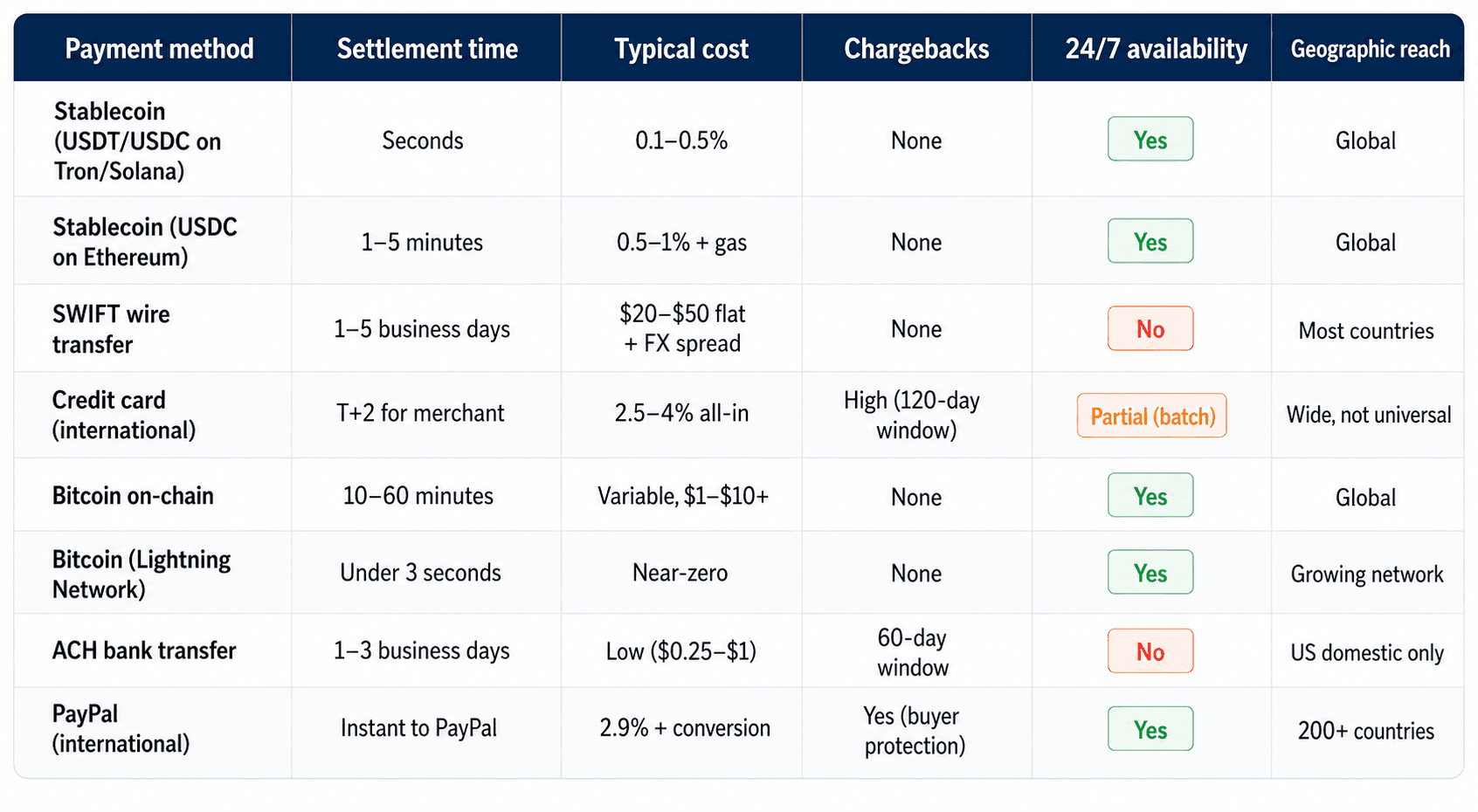
For cross-border B2B payments and international payroll, the case for stablecoin rails over SWIFT wires is clear on both cost and speed. For domestic retail, where the card infrastructure is already in place, Lightning Network payments complement stablecoins.
For global eCommerce, where buyers prefer familiar instruments, stablecoins work alongside card options.

What to look for in a stablecoin payment gateway?
The gateway a business selects determines settlement speed, compliance exposure, integration options, and operational flexibility for as long as the integration runs. Several criteria matter more than others.
Multi-stablecoin, multi-chain support
A gateway that only supports USDC on Ethereum misses the majority of global stablecoin users. The right infrastructure accepts USDT on Tron (the lowest-cost network), USDC on Solana, and Base (fast and inexpensive), and both on Lightning (low cost + fast).
Restricting the payment methods to one stablecoin on one chain restricts the customer base.
Settlement flexibility
Businesses need the option to hold the received stablecoin, convert it to Bitcoin, or off-ramp to fiat in their local currency. A gateway that forces a specific settlement path reduces the business’s ability to manage treasury strategy.
Speed’s on-ramp and off-ramp product handles fiat-to-crypto and crypto-to-fiat conversion with the same-day ACH settlements directly to a business bank account.
Compliance infrastructure is already built
Building KYC/AML screening, sanctions checking, and transaction monitoring in-house is expensive and technically complex. A business-grade payment gateway includes this as part of its core service, not as an optional add-on.
This is especially relevant under the GENIUS Act and MiCA, where compliance requirements are moving from voluntary to mandatory.
Integration depth
REST APIs, webhooks, payment links, and POS integrations should all be available. A manufacturing business using custom ERP software needs a different integration path than a Shopify merchant or a restaurant using a kiosk.
Speed's Connect product covers API, POS, and platform-level integrations with full developer documentation at docs.tryspeed.com.
Security certification
SOC2 Type 2, PCI-DSS, and ISO 27001 are the baseline certifications a business-grade payment gateway must hold. These are not marketing badges; they represent audited controls and third-party verified security practices. Speed holds all three.
View Speed's security certifications.
Settlement speed
A gateway with Lightning Network infrastructure and multi-chain stablecoin support settles in under 3 seconds. This is the practical threshold for real-time business payments, not a benchmark to compare against the card's T+2 cycle.
Compare payment methods and pricing
See exactly what Speed charges for stablecoin payments vs. what your business pays now with cards and wires.
How does speed power stablecoin payments for businesses?
Speed is a Lightning Network Bitcoin and stablecoin payment infrastructure built for global businesses. It processes Bitcoin, USDT, and USDC payments across 100+ countries, has processed over $10 billion in payments, maintains 99.99% uptime, and settles in under 3 seconds.
Speed is backed by Tether and ego death capital and operates under MSB license CoinX USA LLC.
Speed's product suite covers every stage of the stablecoin payment lifecycle.
Accept USDT and USDC payments
Speed’s payment product allows businesses to start accepting USDT and USDC (and Bitcoin) in under 5 minutes. Three integration paths are available depending on the business’s technical setup:
Payment links require no code. A merchant generates a link in the Speed dashboard, sends it via invoice or email, and the customer pays in their preferred currency. Ideal for freelancers, service businesses, and B2B invoicing.
API integration embeds stablecoin payments directly into a custom checkout flow. Speed’s REST API supports checkout sessions, webhook notifications, and automated settlement logic.
Plugin integration covers WooCommerce and WordPress merchants, connecting stablecoin payment acceptance to an existing store without custom development.
All three paths produce the same outcome: zero chargebacks, instant settlement, and stablecoin receipts recorded in the Speed dashboard for accounting and compliance purposes.
Real-time global payouts
Speed's Payouts product allows businesses to send USDT, USDC, or Bitcoin to recipients anywhere in the world in real time. For platforms with large seller or contractor bases, this replaces slow international bank transfers with near-instant on-chain settlements.
Payout batches can be processed simultaneously, all 200 recipients in a single batch, rather than 200 individual wire initiations.
Onramp and offramp for fiat-to-stablecoin settlement
Businesses that want to accept stablecoins but settle in fiat, or fund stablecoin wallets from bank accounts for outbound payments, use Speed's on-ramp and off-ramp products.
It supports ACH and bank transfers, RTP, and FedNow, same-day ACH settlements to a business bank account, and zero-fee recurring purchases of Bitcoin, USDT, or USDC.
Business onboarding for the onramp/offramp product completes in 24–48 hours through a KYB process requiring business registration documents, EIN confirmation, and government-issued ID for authorized signers.
Compliance and security built in
Speed operates under a full compliance framework: SOC2 Type 2, PCI-DSS, ISO 27001, and KYC/AML. Businesses using Speed inherit an audited compliance infrastructure rather than building their own.
For businesses in regulated industries or jurisdictions, this materially reduces the compliance overhead of adding stablecoin payments.
Speed is backed by CoinX USA, LLC’s FinCEN MSB registration and compliance program and operates within the frameworks established by the GENIUS Act, relevant for US businesses as implementing regulations roll out through 2026 and 2027.
Connect: Fintech and PSP platform integration
Speed Connect allows fintech platforms and payment service providers to integrate the Lightning Network and stablecoin payment capabilities into their own platforms.
This is built for platforms that want to offer stablecoin payment acceptance to their merchants without building the underlying infrastructure.
Speed’s fintech and PSP platform support covers kiosk integration, next-generation POS systems, and compliance-ready payment tooling for platforms that process payments on behalf of others.

How to set up stablecoin payments with Speed?
Step 1: Create a Speed account
Sign up to app.tryspeed.com/register. Account setup takes under 5 minutes. KYC verification is handled during onboarding, covering identity verification and business documentation where required.
Step 2: Choose the right integration method
Three paths are available. Payment links work for businesses receiving payments via invoice or one-time requests that are generated in the dashboard, shared with the customer, settled in USDT, USDC, or Bitcoin with no code required.
API integration is the right path for eCommerce platforms, SaaS businesses with subscription billing, or any business that needs stablecoin payments embedded in a custom checkout flow.
Speed terminal covers in-person stablecoin payments for physical retail, restaurants, and hospitality businesses.
Step 3: Configure settlement preferences
Businesses choose whether to hold received stablecoins, convert to Bitcoin, or off-ramp to fiat. Settlement preferences are set at the account level and can be adjusted over time as the business’s treasury needs evolve.
Step 4: Enable payouts for platforms and B2B
Businesses that need to send payments to suppliers, sellers, contractors, or employees can configure Speed Payout. Recipients receive USDT, USDC, or Bitcoin to any compatible wallet in real time, across 100+ countries.
Step 5: Monitor and reconcile transactions
Speed Dashboard provides real-time transaction monitoring, payment history, settlement records, and compliance reporting. For businesses that need audit-grade records of stablecoin transactions, the dashboard covers the full lifecycle from payment initiation to settlement confirmation.
Set up stablecoin payments in under 5 minutes
Speed accepts USDT and USDC with instant settlement, zero chargebacks, and built-in compliance infrastructure.
The data picture: Stablecoin payments in numbers
The market data available through early 2026 gives a consistent picture of where stablecoin payment adoption is heading and how fast.
Total stablecoin on-chain transfer volume in 2025 reached $33 trillion, a 72% year-over-year increase (Artemis Analytics/Bloomberg). This exceeded the combined 2025 volume of Visa ($14.2 trillion) and Mastercard ($11.3 trillion).
Circle reported $11.9 trillion in USDC on-chain volume in Q4 2025 alone, up 247% year-over-year. Stablecoin market cap crossed $300 billion in early 2026, with USDT and USDC accounting for over 95% of supply. More than 232 million blockchain addresses hold stablecoins (RWA.xyz).
The cross-border payment data is where the business case is sharpest. The BIS estimates cross-border flows between USDT and USDC at approximately $400 billion per year. Stablecoin cross-border payments cost 0.1-0.5% of transaction value vs. 6% + for traditional remittance.
EY-Parthenon projects that stablecoin cross-border payments will represent 5-10% of the total cross-border payments market by 2030, translating into $2.1-$4.2 trillion in cross-border payments.
The stablecoin supply could reach $3 trillion by 2030.
— Scott Bessent, U.S. Secretary of the Treasury
Corporate adoption data from the EY-Parthenon post-GENIUS Act survey shows 13% of companies already using stablecoins for payments, 54% planning to adopt within 6-12 months, and 41% of current users reporting cost savings of at least 10% on cross-border payments.
McKinsey and Artemis Analytics found that stablecoin payment activity, vendor payments, remittances, payroll, and B2B settlements have doubled in 2025 to approximately $390 billion. McKinsey separately estimated stablecoin-linked card spending at $4.5 billion in 2025, up 673% from the prior year.
At the merchant level, Speed’s own data shows USDC merchant payment volume growing 337% between 2024 and H1 2025, and 87% of all stablecoin payment collections coming from stablecoins (vs. 9% from Bitcoin and Ethereum combined) across invoice payments and checkout flows.
Explore how global businesses use Speed
From Steak 'n Shake to Maxim, see how real businesses have reduced costs and accelerated settlement with stablecoin payments.
Practical questions businesses raise before adopting stablecoins
Do customers actually pay in stablecoins?
It depends on the customer segment and geography. In markets with historically volatile local currencies like Turkey, Argentina, and Nigeria, customers actively prefer dollar-denominated digital payments as a store of value and a spending medium.
In crypto-native markets (online gaming, digital media, SaaS with tech-forward buyers), significant portions of users hold and prefer to spend stablecoins. For general eCommerce, stablecoin payments serve a growing but still specific segment and work best alongside card acceptance rather than replacing it.
How are stablecoin receipts accounted for?
In the US, received stablecoins are treated as property. Each receipt may be a taxable event if the stablecoin was acquired below or above its cost basis. Businesses that immediately convert received stablecoins to fiat treat them similarly to foreign currency transactions.
Most businesses use stablecoins as a payment pass-through, accept, and immediately convert, facing minimal tax complexity. Jurisdiction-specific guidance from a qualified accountant is the appropriate step before launching stablecoin acceptance.
What happens if the stablecoin loses its dollar peg?
Both USDT and USDC have maintained their peg with remarkable consistency across multi-year market cycles. USDC’s reserve composition (cash and US Treasuries with monthly attestations) represents the lower-risk option.
The most notable historical depeg event was the March 2023 USDC temporary deviation during the Silicon Valley Bank crisis, which lasted approximately 56 hours before full recovery. For businesses that convert immediately upon receipt, peg risk is minimal.
For businesses holding stablecoins in the treasury for extended periods, USDC’s reserve transparency is a factor in the risk assessment.
Is it legal to accept stablecoins as a business?
Accepting stablecoins as payment is legal for businesses in the United States under the GENIUS Act framework and in the EU under MiCA. Businesses accepting stablecoins are payment recipients, not stablecoin issuers, and face different and lighter compliance obligations than PPSIs.
The primary requirements are KYC/AML compliance at the payment gateway level and accurate record-keeping for tax purposes.
Start accepting stablecoin payments with Speed
Speed accepts USDT and USDC across 100+ countries, with a 5-minute setup, instant settlement, zero chargebacks, and full compliance infrastructure included.
FAQs
What are stablecoin payments for businesses?
What is the difference between USDT and USDC for business payments?
Are stablecoin payments legal for businesses?
How much does it cost to accept stablecoin payments?
How quickly do stablecoin payments settle?
Can a business receive stablecoins and settle in fiat?
What blockchains support USDT and USDC payments?
Let’s Build Together