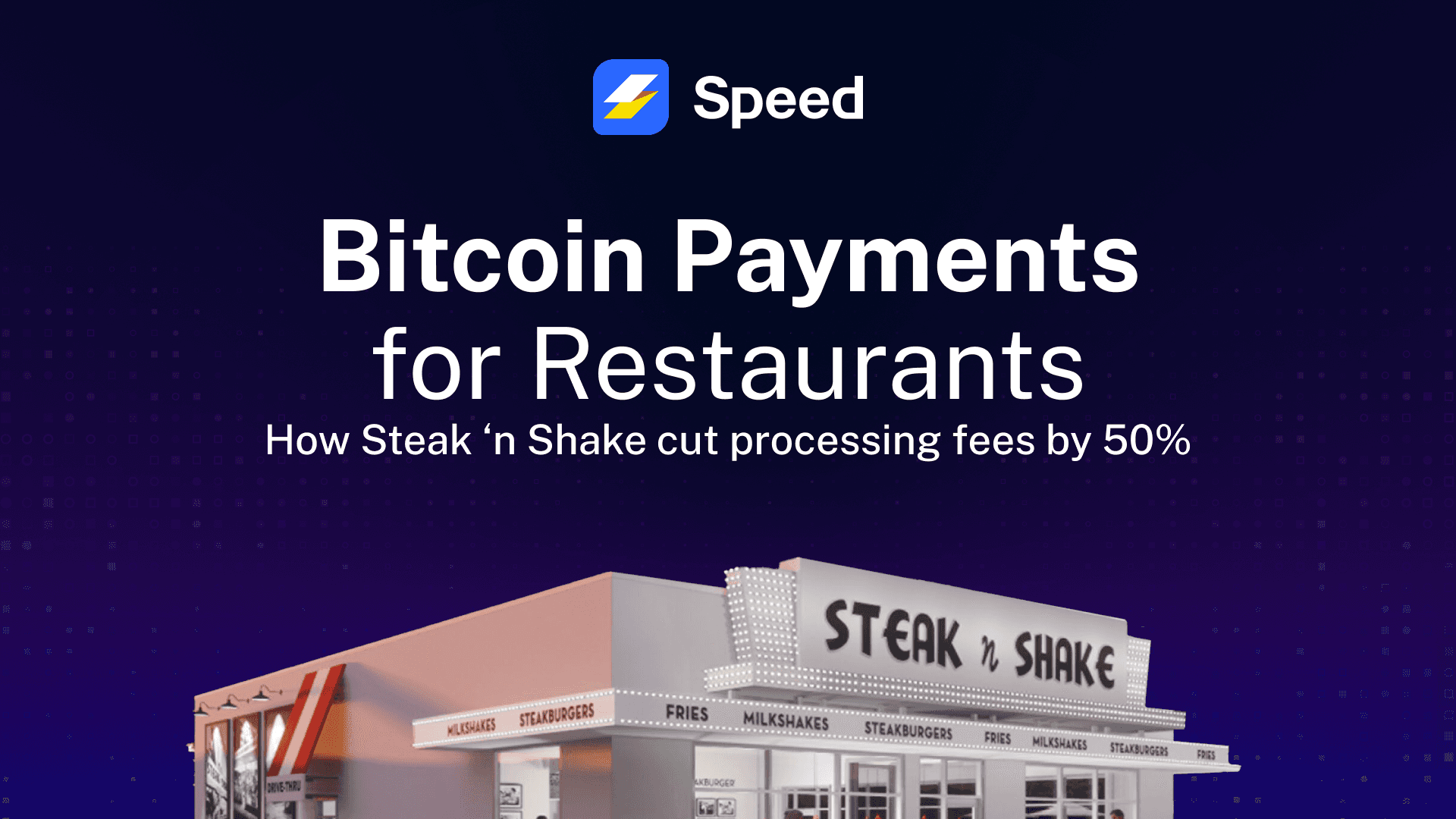
Steak 'n Shake reduced its payment processing fees by 50% by accepting Bitcoin payments. Here's how lightning payment infrastructure is helping restaurants.
TL;DR
Steak 'n Shake cut processing fees 50% at 393 U.S. locations using Bitcoin Lightning payments
Saved $32,400 annually (from $62,640 to $30,240 in processing costs)
Implementation took days (not months) using Speed's Lightning payment infrastructure
Zero hardware replacement needed, integrated with existing POS systems
Lightning Network settles in 2-5 seconds vs 2-3 business days for cards
First major U.S. QSR chain to accept Bitcoin payments nationwide
15% customer adoption was enough to achieve 50% cost reduction
The restaurant payment processing problem nobody talks about
Every time a customer swipes their card at a restaurant, 2-3% of that transaction disappears.
For a restaurant doing $2 million in annual revenue, that's $60,000 straight to payment processors. The money vanishes before it hits the merchant account.
Steak 'n Shake faced this problem across 393 U.S. locations. On May 16, 2025, they became the first major fast-food chain to accept Bitcoin payments at every store simultaneously and cut their processing fees in half.
Restaurant profit margins average 3-5%, and when payment processing consumes half of that, the business model breaks down.
What traditional payment processing costs restaurants?
The fee structure most restaurant owners accept as "standard" is actually crushing the business margins.
Fee Component | Amount | Annual Cost (50K monthly volume) |
Transaction fee | 2.3% - 3.5% | $13,800 - $21,000 |
Per-swipe fee | $0.10 - $0.30 | $360 - $1,080 |
Monthly gateway | $15 - $50 | $180 - $600 |
PCI compliance | $100 - $200/year | $100 - $200 |
Chargeback fees | $15 - $25 per dispute | $500 - $2,000 (avg) |
Total annual cost | $14,940 - $24,880 |
A single location processing $50,000 monthly in card transactions pays $15,000-$25,000 per year just in processing fees. For a chain like Steak 'n Shake with 393 locations, that's over $6 million annually.
Why did Steak 'n Shake choose Bitcoin Lightning payments?
Restaurant chains don't make technology decisions lightly. Before integrating fully, Steak 'n Shake tests customer sentiment before committing via a social media platform.
They posted on social media, asking their audience about accepting Bitcoin payments. The response was overwhelming. Crypto users were ready worldwide, and Steak 'n Shake responded.
Three factors drove the decision:
Customer demand: 30% of the U.S. population has adopted crypto. These customers actively look for places to spend Bitcoin.
Economic pressure: Processing fees were eating into margins. Traditional payment networks offered no relief.
Technology readiness: Speed's Lightning payment infrastructure for restaurants made implementation possible without replacing existing systems.
How Lightning payments differ from traditional processing
The Bitcoin Lightning Network operates outside traditional payment rails. No intermediary banks. No card networks. No 2-3% fee per transaction.
Payment Method | Transaction Fee | Settlement Time | Chargeback Risk | Network Fee |
Credit cards | 2.3% - 3.5% + $0.10-$0.30 | 2-3 business days | 0.5% - 2% dispute rate | N/A |
Bitcoin (base layer) | 0.5% - 1% | 10-60 minutes | 0% (final) | $0.50 - $5.00 |
Lightning Network | 0.5% - 1% | 2-5 seconds | 0% (final) | $0.01 - $0.03 |
For a $15 burger order, Lightning payment processing makes economic sense. The customer pays instantly, the restaurant confirms in seconds, and network fees barely register.
The Steak 'n Shake case study: Real numbers from 393 locations
Steak 'n Shake partnered with Speed's Lightning payment processor to roll out Bitcoin payments across all U.S. locations simultaneously.
Before Lightning payment integration:
Locations: 393 U.S. restaurants
Average monthly card volume per location: $180,000
Processing fee rate: 2.9%
Monthly processing cost per location: $5,220
Annual processing cost per location: $62,640
After Lightning payment processor adoption:
Customer adoption rate: 15% chose Lightning/stablecoin payment
Lightning payment processing fee: 0.8%
Monthly processing cost (mixed): $4,520
Monthly savings per location: $700
Annual savings per location: $8,400
Chain-wide impact (393 locations):
Total annual processing cost before: $24.6 million
Total annual processing cost after: $17.8 million
Total annual savings: $6.8 million
COO Dan Edwards announced at the Bitcoin 2025 Conference: "With Bitcoin adoption, we witnessed a 50% reduction in processing fees compared to credit card payments."
How Bitcoin Lightning payments work in quick-service restaurants
At a glance: The customer experience stays familiar. The backend changes completely.
Traditional card payment flow:
Customer swipes card → 2-5 seconds authorization
Payment processor verifies with issuing bank
Transaction approved or declined
Funds held by processor → 2-3 business days
Settlement to restaurant account minus 2.9% fee
Lightning payment flow with Speed:
Customer scans QR code at register → Lightning wallet opens
Confirms payment amount → sends transaction (3 seconds)
Lightning Network confirms instantly
Speed's Lightning payment infrastructure converts to USD (optional)
Funds available same day minus 0.8% fee
Steak 'n Shake's Head of IT Jeff Goehring confirmed: "Speed has implemented this system for us and the implementation is smooth throughout our U.S. locations."
Why stablecoins matter for restaurant payments?
Most restaurants don't want Bitcoin price volatility. They need stable value with lower fees.
Stablecoins solve this problem. USDC and USDT are digital dollars, always worth $1.00 and move on Lightning Network rails with Speed.
Stablecoin advantages for restaurants:
Feature | Traditional USD | Stablecoins on Lightning |
Value stability | $100 = $100 | $100 = $100 |
Settlement speed | 2-3 business days | 2-5 seconds |
Cross-border capability | Limited, expensive | Global, instant |
Processing fee | 2.3% - 3.5% | 0.5% - 1% |
Chargeback risk | 0.5% - 2% | 0% |
Speed's Lightning payment processor uses Bitcoin and stablecoins for restaurant transactions. The customer pays in Bitcoin, and the restaurant receives USD if they opt for it, reducing the volatility exposure.
Where Lightning payment infrastructure creates the most value
Certain restaurant operations benefit more from Lightning payments than others.
High-volume quick service (like Steak 'n Shake):
Fast food chains process thousands of small transactions daily. The $0.10-$0.30 per-swipe fee on cards adds up fast. Lightning Network charges $0.01-$0.03 regardless of transaction size.
Tourist-heavy locations:
International customers avoid currency exchange fees. They pay directly with Lightning payments, and the restaurant receives local currency instantly through Speed's infrastructure.
Drive-through operations:
Steak 'n Shake integrated Lightning payments across all drive-through lanes. Customer scans QR code on screen, pays in 3 seconds, transaction confirms before reaching the window.
Digital ordering platforms:
Mobile app and kiosk users are already comfortable with QR codes and digital wallets. Natural fit for Lightning payment wallets.
Catering and large orders:
Big-ticket transactions where 2.9% processing fee = $14.50+ per $500 order. Lightning payment saves $8-12 per large order while settling instantly.
Speed's Lightning payment infrastructure: What makes it work for restaurants
Speed built Lightning payment infrastructure specifically for businesses that want crypto's benefits without complexity.
Key features for restaurant operations:
Instant stablecoin conversion
Accept Bitcoin Lightning payment, receive USD. No holding crypto, no volatility exposure. Speed's infrastructure handles conversion automatically within seconds.
Existing POS integration
Works with Square, Clover, Toast, and most major restaurant POS systems. No hardware replacement. API connects to existing infrastructure.
Multi-channel support
Steak 'n Shake deployed across kiosks, drive-throughs, mobile ordering, and counter service, all using the same Speed backend.
Real-time transaction dashboard
Track Lightning payments alongside card transactions. Monitor adoption rates. Calculate fee savings. Custom reporting for finance teams.
Built-in compliance
Speed's Lightning payment processor manages KYC, AML, and regulatory requirements. Restaurants focus on operations.
Explore Speed's restaurant solutions →
Implementation timeline: How Steak 'n Shake rolled out in days
Most payment infrastructure changes take months. Steak 'n Shake went live in days.
Timeline | Activity | Speed Support |
Day 1-2 | Account setup, verification | Speed team provided dedicated onboarding |
Day 3-5 | API integration testing | Technical documentation + developer support |
Day 6-7 | Staff training (5 min per person) | Training materials + demo videos |
Day 8-10 | Soft launch at pilot locations | Real-time monitoring + troubleshooting |
Day 11+ | Full rollout to 393 locations | Seamless deployment across all channels |
Traditional payment processor changes typically require:
Hardware replacement: 2-4 weeks
Staff retraining: 1-2 weeks
System integration: 4-8 weeks
Total time: 2-3 months minimum
Speed's Lightning payment API eliminated these delays.
Real-world Lightning payment scenarios at Steak 'n Shake
Drive-through customer (most common):
Customer orders at the speaker
The screen displays a QR code with the amount due
Customer scans with the Lightning wallet app
Payment confirms in 3 seconds
Customer proceeds to the window, order ready
Kiosk ordering:
Customer builds order on touchscreen
Selects the "Pay with Bitcoin" optionThe
QR code appears on the kiosk screen
Scans and pays, receipt prints automatically
Kitchen receives the order instantly
Mobile app pre-order:
Customer places an order through the Steak 'n Shake app
Checks out with the Lightning payment option
Pays via integrated wallet
Arrives at the store, order already prepared
No additional payment needed at pickup
Each scenario demonstrates Speed's Lightning infrastructure handling real restaurant operations.
The competitive advantages Lightning payments created
Steak 'n Shake gained multiple benefits beyond lower fees.
Cost savings breakdown by adoption rate:
Lightning Payment Adoption | Annual Processing Cost | Annual Savings | Savings % |
0% (cards only) | $62,640 | $0 | 0% |
10% Lightning | $56,700 | $5,940 | 9.5% |
15% Lightning (actual) | $53,760 | $8,880 | 14.2% |
25% Lightning | $47,820 | $14,820 | 23.7% |
50% Lightning | $31,320 | $31,320 | 50% |
At just 15% adoption, Steak 'n Shake achieved significant savings. As more customers adopt Lightning payments, savings increase proportionally.
Marketing momentum:
The Bitcoin integration delivered free publicity. Viral social media moments, Bitcoin Conference 2025 sponsorship, high-profile industry appearances—all without paid campaigns.
Brand differentiation:
"We accept Bitcoin" attracts crypto-native customers. These customers often have higher disposable income and spend more per visit.
Adopting Crypto Payments!
Read more about crypto customer demographics and the reason why businesses are adopting crypto payments.
Cash flow improvement:
Same-day settlement improves working capital. Pay suppliers faster with funds from Lightning payments. Negotiate better terms. Manage cash flow more efficiently.
International appeal:
Tourists and international visitors can pay without currency exchange hassles through the Lightning Network. This demographic represents high-value transactions.
What other restaurants are doing with Lightning payments?
Steak 'n Shake isn't alone. The Lightning payment trend is accelerating across the restaurant industry.
Chipotle tested Bitcoin Lightning payments at select Miami locations. Attracted crypto-wealthy customers in a crypto-friendly market with instant payment confirmation.
Burger King Brazil accepts Bitcoin Lightning payments nationwide. Partnered with a Lightning payment processor for instant conversion to Brazilian real.
Independent restaurants in Austin, San Francisco, and Miami widely accept Lightning payments. These cities have high Lightning Network adoption rates among residents.
Food trucks and ghost kitchens use Lightning payment infrastructure for quick settlements. Mobile-first business model aligns naturally with digital-native payment methods.
El Salvador restaurants (where Bitcoin is legal tender) run on Lightning payment infrastructure. Instant settlements in seconds make Lightning Network the standard for retail.
Early adopters of Lightning payment processing see a competitive advantage. Later adopters need to keep pace.
Addressing common concerns about restaurant Bitcoin payments
"My customers don't use Lightning payments."
Steak 'n Shake saved 50% with just 15% Lightning payment adoption. Even 5-10% makes a measurable difference on fees. Lightning Network user base grows 300% annually.
The ROI doesn't require majority adoption. Every Lightning payment processed saves 1.5-2% compared to cards.
"Bitcoin Lightning payments are too complicated for my staff."
Steak 'n Shake trained staff in 5 minutes per person. The interface is simple: generate QR code, customer scans, payment confirms. Same experience as Apple Pay or Venmo. Backend complexity handled by Speed's Lightning payment infrastructure.
"What about price volatility in Lightning payments?"
Use stablecoins on Lightning Network or instant conversion. Customers pay via Bitcoin Lightning payment, you receive USD through Speed's Lightning payment processor. Zero volatility exposure.
Steak 'n Shake uses instant USD conversion, they never hold cryptocurrency.
"Isn't Lightning payment infrastructure expensive to set up?"
No hardware costs. No integration fees. Speed's Lightning payment API connects to existing POS in days. Steak 'n Shake deployed across 393 locations without buying new terminals.
"What about compliance with Lightning payment processing?"
Speed's Lightning payment processor handles KYC, AML, and reporting requirements. Restaurants receive clean transactions and tax-ready reporting. Lightning Network transactions are fully compliant.
Step-by-step: Setting up Lightning payment processing
Based on Steak 'n Shake's actual implementation with Speed.
Week 1: Setup and testing
Day 1-2: Create, complete verification, activate Lightning payment processor
Day 3-4: Generate test Lightning payment links, run internal transactions on the Lightning Network
Day 5-7: Train staff on Lightning payment process (5 minutes per person)
Week 2: Pilot launch
Select 2-3 pilot locations for soft launch
Offer a Lightning payment option to interested customers
Monitor Lightning Network transaction flow and customer feedback
Adjust QR code placement and Lightning payment instructions
Week 3-4: Full deployment
Roll out to remaining locations using proven playbook
Add Lightning payment option to menus and POS screens
Market new Bitcoin Lightning payment method to customers
Track Lightning payment adoption rates and fee savings
Month 2+: Optimization
Analyze which order types show the highest Lightning payment adoption
Adjust marketing to crypto-friendly customer segments
Calculate actual Lightning payment fee savings vs projections
Scale up as adoption increases
Most restaurants see first Lightning payments within 48 hours of setup on Speed's Lightning payment infrastructure.
Speed's advantages for restaurant operations:
Feature | Traditional Processors | Speed Lightning Infrastructure |
Settlement speed | 2-3 business days | 2-5 seconds (instant) |
Processing fee | 2.3% - 3.5% + fixed | 0.5% - 1% flat |
Integration time | 2-3 months | Days |
Hardware required | Yes (new terminals) | No (existing POS) |
Volatility protection | N/A | Instant USD conversion |
Chargeback risk | 0.5% - 2% | 0% (final transactions) |
API-first design | Legacy systems | Modern, documented APIs |
Compliance handling | Restaurant responsible | Speed manages KYC/AML |
Restaurants need reliable payment infrastructure. Speed delivers that for Lightning payments specifically.